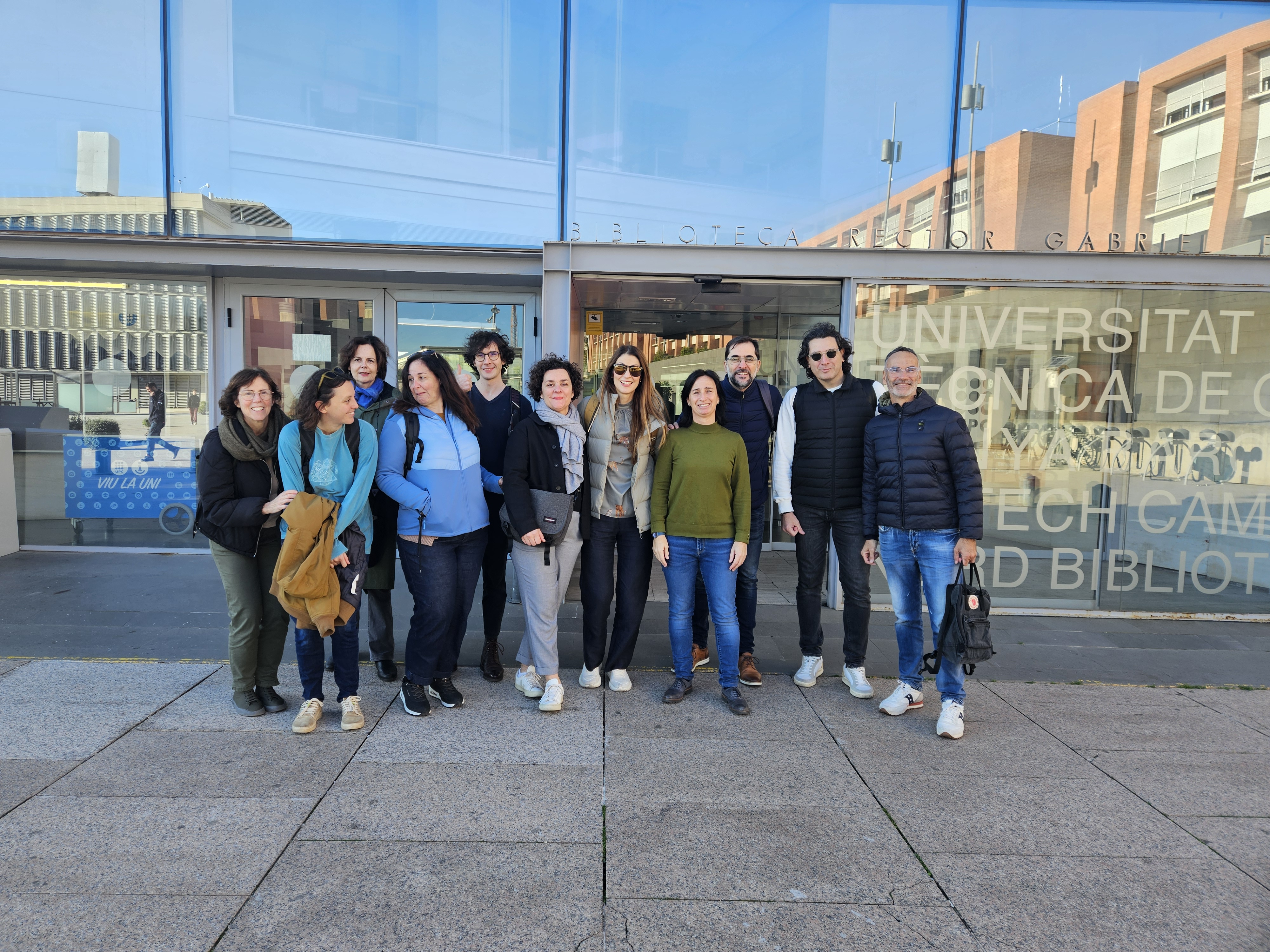
The third and last Familiarization Trip of the LibCommon project took place from the 17 to the 21 November, bringing partners together in Barcelona and the city of Vic.
Over five days, participants explored innovative library models, community-driven initiatives, and new approaches to strengthening the social, cultural and democratic role of libraries. The visits highlighted how public, university and community libraries can act as inclusive spaces that empower citizens, promote literacy and foster civic engagement.
The programme began at the García Márquez Library, where Esther Omella, Judit Terma and Andreu Orte from Diputació de Barcelona introduced the impressive network of 41 libraries that form the Xarxa de Biblioteques Municipals de Barcelona (XBM) and the 241 libraries all around the Barcelona province. They emphasized the library as a redefined public space, a social infrastructure that responds to emerging social challenges and community needs through collaboration seeking territorial balance and equitable access.
With a long history in library services, the Catalan model draws inspiration from the Danish framework’s “four pillars of contemporary public libraries”: discover, learn, create and share. This vision has been implemented since 2018 through the Bibliolab programme which supports libraries in transforming themselves via pilot innovation projects, community initiatives and workshops, offering high quality cultural experiences to their users.
The visit around the 2023 World’s Best Library showcased its multidisciplinary design: flexible areas to meet, read, study, collaborate and create. Two spaces stood out as key examples of inclusion and community-building –the professional radio studio and the sensory space. The first day concluded with an interactive Escape Room from the Bibliolab’s initiative Entre Línies, engaging all partners in a dynamic reflection on disinformation and fake news.
The second day took place at the Rector Gabriel Ferraté Library (Polytechnical University of Barcelona), where Carme Fenoll, leader of cultural policy in the university, led a powerful discussion on how public and university libraries can foster democracy and civic engagement. The workshop explored how strengthening connections –between students in technical fields and the arts, between public and academic libraries, and between libraries and local organizations –can widen participation and enrich learning. The Erasmus Travel Human Library initiative emerged as an inspiring example, linking future Erasmus students with former participants.
The debate evolved towards the urgent need to reinforce children’s literacy in Catalonia through stronger school libraries, and how LibCommon could contribute to addressing this challenge. Carme closed with a resonant message: in complex times like these, defending libraries means defending critical thinking and democracy.
The day continued with a visit to the Sagrada Família Library, where partners explored a science-oriented Bibliolab project focused on citizen science.
Then, Mònida Medina, Director of Torras i Bages Library in the city of Vilafranca (Barcelona) exposed a powerful project that connects the library with a Justice centre for teenagers aged 14–18 who have court sentences. The following P2P session was passionate about how public, university, school and other spaces libraries shaped as a common good can become key spaces for inclusion, democracy and literacy.
The third day started out in Santa Coloma de Farners, at the Biblioteca del Fondo, where cultural rights expert Nicolás Barbieri discussed the public value of commons-based libraries. Barbieri highlighted the need to address social and cultural inequalities, the importance of collective action and cooperation and a shift from seeing users as people with needs to viewing them as individuals with capacities who contribute to public value.
This was followed by Montse Álvarez’s presentation “Innovative libraries, active communities: rebuilding the commons”, showcasing Bibliolab initiatives such as Llegim el Riu – Reading the river (promoting citizen science and environmental research) and the Ecological Transition Lab, a collaborative learning community within XBM that helps libraries assess and improve sustainability. Later, Marta Serrano, director of the library, explained how this space has become a cultural hub for its diverse community using cooking workshops as an intercultural bridge, particularly empowering local women.
The afternoon focused on the Bibliobus near Vic (Montesquiu). This mobile library service born in 1995 operates in most rural areas in the Barcelona province extending access to books, cultural activities and essential services to small and isolated communities. The key idea is the library travels to rural citizens because, in some cases, they cannot go to the library in the city. Flexibility, adaptability, proximity and personalised service are the main characteristic of a service which is highly valued by the rural areas’ citizens. The P2P session addressed how to overcome geographical, physical, symbolic and other barriers that hinder access, use and participation in libraries for diverse and unequal communities.
The fourth day took place at the University of Vic Library where Gemma Mascaró and Cristina Clotet described how the library supports and promotes the ULibraryLab, which provides training activities within academic programmes and presented cultural activities held both inside and beyond the small library space. Yannis Petchelidis then presented new possibilities for cross-partner collaboration, followed by Antoine Henry’s update on the development of the LibCommon online course syllabus. After this, a tour around the university campus led participants to an even smaller mobile library concept displayed in the Montessori space of the university, designed to reach small towns and built as an interactive piece of furniture.
In the afternoon, partners visited two projects in Vic. On one hand, Biblioteca de les Coses (Library of Things), a partnership between local organizations, offers citizens access to a wide range of items for free or a symbolic fee. The same logics of libraries (common use and not possession) is applied to many different areas such as household electric appliances, special clothes and complements or games. On the other hand, the Montseny community library professionals exposed how, after a participative process, a 30-year-old communitarian library has become a key space for extracurricular activities for disadvantaged students.
The trip concluded with a guided visit to the Pilarín Bayés Library, led by coordinator Ignasi Janer. This pioneering initiative aims to counter stigmatization in the neighbourhood by balancing the library’s traditional functions with a strong social and cultural mission. The multidisciplinary staff works closely with local residents—particularly teenagers—with the support of a social worker. Reflecting Vic’s strong musical culture, the library also includes a recording studio, where many emerging artists have produced their first EPs.
A final wrap-up session included a presentation by Eduard Ramírez on a collaborative project between schools, universities and the library, followed by a collective reflection acknowledging the rich learning obtained across all three Familiarization Trips. These insights will guide the next stages of LibCommon and help scale its impact.